I completed the Extended Project Qualification (EPQ), which is an independent research project taken alongside A-levels.
I chose to do mine on Scam Compounds in Southeast Asia, and decided to present my findings in the form of a documentary and essay.
This was a 9-month project, so please take a look at my findings in the blog post!
In September 2025, I started the Extended Project Qualification (EPQ). At the time, I was planning to do a 5000-word essay which is what most people do.
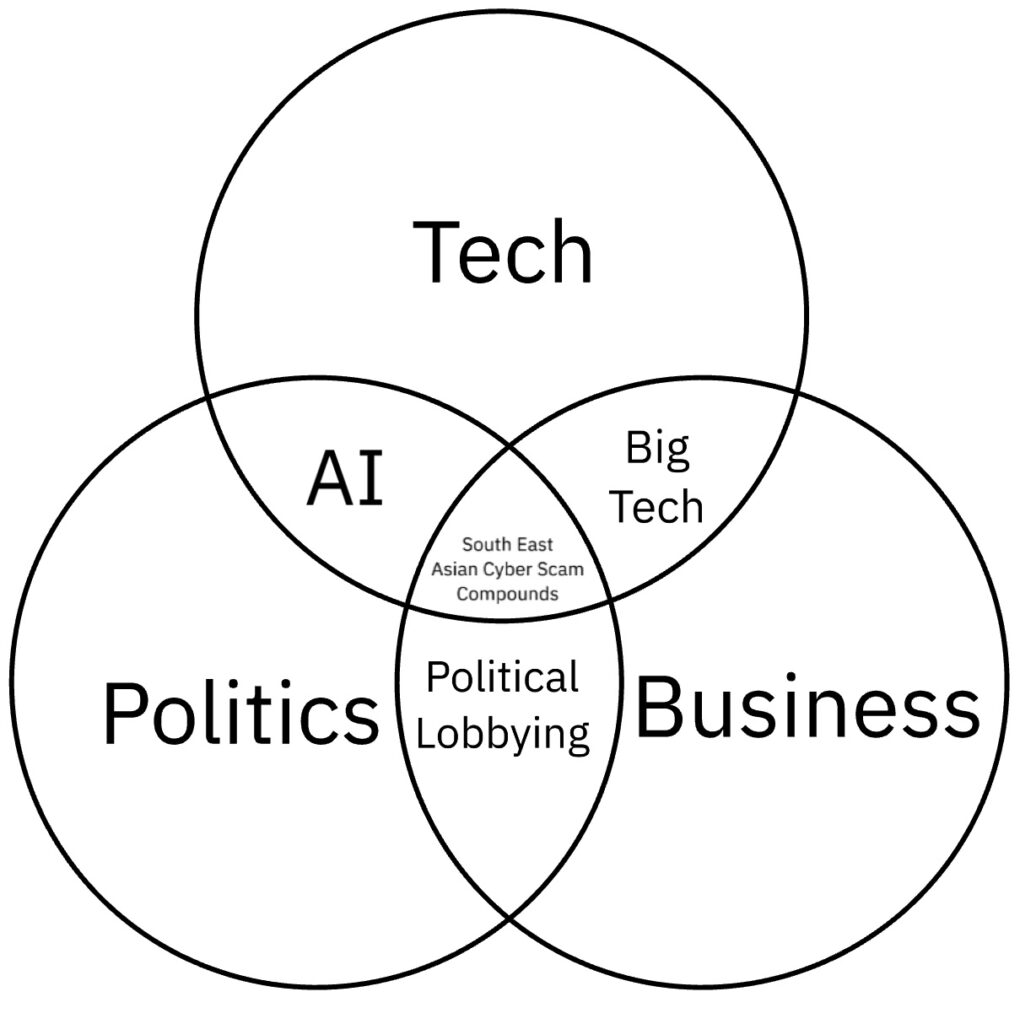
I wanted to choose a topic that linked my interests together, helped me better understand the fields I am considering for the future, and kept me genuinely engaged throughout the project.
I think I have beautifully illustrated my thought process with this Venn diagram.
Later on I decided to change my EPQ from being essay-only to an artefact (which in my case was a documentary) and an essay.
The Documentary
The Essay
How do Southeast Asian scam compounds work and how do they play a factor in world order?
My project aimed to produce a short documentary explaining how Southeast Asian scam compounds operate and how they create wider financial, social and geopolitical consequences. I chose a documentary as the medium because the topic involves human stories and complex systems. The documentary format allowed me to use visual storytelling in the form of green-screen explanations, acted scenes and maps. I believed this would be more engaging for a wider audience, which would allow me to communicate the story and overall message to more people. My target audience was older teenagers aged sixteen and over, and adults with little knowledge of cybercrime, particularly in the Southeast Asia region. I specifically chose this target audience since sensitive topics are discussed in the documentary such as human trafficking and physical abuse. My success criteria were that the final documentary would be understandable to a non-specialist audience, captivating for those watching, sensitive to both victims and survivors involved, factually accurate and that key factual claims could be verified using a source table.
Initial Planning
My original plan was to focus specifically on scam compounds in Myanmar and how they generally worked. But as I began researching, I found that this was a much more widespread issue around the world than I initially thought. Although Myanmar remained an important case study, my research suggested that scam compounds were especially concentrated in areas with weak governance, corruption or civil conflict such as Cambodia, Laos and cross-border areas around a region known as the Golden Triangle. This led me to conclude that my question was too region-specific, so I decided to focus more broadly on Southeast Asia where many of the most prominent scam compounds have been reported.
I also realised that “how scam compounds work” was also a very broad topic so I initially divided my research into different sections: a scam case study, the region where the compounds are located, how the scam worked, the role of Chinese organised-crime networks, human trafficking (as a case study) and what we can do as a society. This structure was revised later on as my research developed, since I wanted to show a more linear story of how a combination of global events such as the Covid-19 pandemic and weak governance has led to where we are today. This makes it easier for a non-specialist audience to follow along.
Research
I began by listening to a long-form source which was a podcast called “Scam Inc.” by the Economist. This gave me a great framework to base my research on, as it was a ten-episode podcast focused on online cyber scam compounds in Southeast Asia. While this podcast did focus on some of the main parts of my topic such as the victims of the crimes, I recognised the need for some more in-depth sources in specific fields, such as on the geopolitics and money laundering side. Although the Economist is a reputable news organisation, I did not treat the podcast as enough evidence on its own. To reduce the risk of factual inaccuracy, I verified key claims using official reports and legal sources. A significant amount of the research in the podcast, however, was first-hand and original reporting, specifically victim testimonies. For this reason, I made sure to put the podcast into my source table.
I also used visual sources, including a YouTube video of someone going into the “Golden Triangle” zone, which is a border region between Laos, Myanmar and Thailand partly run by a Chinese crime syndicate for activities such as online scams and illegal casinos. This showed me the infrastructure and scale of one of the most visible scam compounds which I have researched, which made me aware of how lucrative criminal operations can be. I made sure to not use any facts which didn’t have sources to back them up. As a result, I only used details from the video that I could verify by matching his location to satellite imagery.
For my money-laundering section, I watched a YouTube video which investigated one of the biggest ways Chinese criminal groups get stolen money to western countries through a practice known as “Flying Money”. This is done by creating a series of agreements between parties to exchange currencies without crossing borders. This YouTube video also included a document with sources, which I made sure to verify and add to my source table.
As well as YouTube, I also used Al Jazeera due to their in-depth reporting on Southeast Asian scam compounds, particularly in Cambodia and Laos. While they did provide victim stories, they weren’t directly useful for my chosen narrative and the Economist testimonies were much more comprehensive and in-depth, so I decided not to include any in my documentary from Al Jazeera.
Scripting
I chose to first write the narration and dialogue before planning the shots because the script needed to provide the documentary’s main structure. I originally wrote the script in a style which was understandable when written down, but some sections were difficult to deliver naturally when spoken aloud. I revised those parts of my documentary to be more conversational and easier to understand for non-technical viewers.
I also used short section titles to show changes in focus. For example, before speaking about the role of Chinese organised-crime networks, I wrote “Part 2 – China” with some different music. This was to show that there is a distinction in location and people from the previous section, without giving too much away about what I was yet to speak about. It also allowed the documentary to be more accessible for people who weren’t familiar with what I was speaking about such as Chinese triad groups.
I also decided that I wanted victim testimonies to be performed by actors because I believed this would make it clearer and more engaging. This allowed me to keep the testimonies close to the survivor accounts reported in my sources because the actors could speak in first person. I made sure to make clear that what was being said was based on true stories through the use of captions which would be added in the editing stage.
I also wanted to dramatise a message exchange between a victim and a scammer, showing how an innocent, realistic-looking profile could easily be someone malicious. To do this, I prepared dialogue which would be texted out by the victim. This changed later on as filming started however, to make it more conversational and to emphasise the manipulation done to the victim.
When choosing where to shoot each scene, I took into account what I would be speaking about. I planned to not be speaking in front of a green screen for too long as I wanted to keep the documentary engaging. For this reason, where possible, I filmed in real places which linked to my topic. For example, when I was talking about money laundering using casinos, I stood in front of a real casino sign.
Overall, these scripting and filming choices helped to make my artefact clearer and more engaging.
Production and Editing
During production, I aimed to use the scene to emphasise the points I was making and to make it easier to understand. I did not want to rely too heavily on green-screen narration as I wanted to make sure that the artefact felt more documentary-like rather than a lecture.
I used a green screen for more complex sections where I could use graphics to illustrate my point.
For example, when explaining money laundering and how criminal networks communicate with each other to move money across borders, I animated graphics with arrows behind me to explain the relationships between parties. This helped to make the explanation clearer for a non-specialist audience.
I also used maps and visual staging to explain geography. For example, when discussing the layout of the Golden Triangle, I had actors wear country flags to represent Myanmar, Laos and Thailand around me while I was explaining. This added an element of interaction, as I could gesture and use props in the form of money to show the countries affected by corruption and organised crime.
During editing I made sure to choose appropriate music for each section to control the tone of what I was saying. In some parts, I wanted it to feel very chaotic, so I put loud, fast-paced music to make it more intense for the viewer.
In more serious or reflective scenes, I slowed the music down and made it quieter so the viewer could focus on what was being said.
I also made sure that music wasn’t too loud in any of the scenes, because I wanted to prioritise clarity over dramatic effect.
I also added relevant images during editing to support narration along with a click sound effect. This was to draw the viewer’s attention to new information shown on screen. I made sure to put captions on photos and videos that I had sourced from the internet, to make it clear where they came from and give credit where needed. This helped me meet my aim to keep the artefact clear, engaging and factually evidenced.
Problems and improvements
One of my main problems initially was that my topic was very large, which led my research to be quite vast. My research covered the history and location of scam compounds, pig-butchering scams, human trafficking, money laundering, crypto currency, geopolitics, online marketplaces, property and investments. It would have been impossible to include everything in full detail in a thirty-minute documentary, especially since I had multiple case studies for each one. I therefore prioritised the topics that were most important to explaining the scam-compound system: pig-butchering scams, the history behind the scam compounds, money laundering and the geopolitics with about one to two case studies for each. While this still sounds like a lot, each of these topics link in many ways with each other, so I could bring case studies together rather than having to research separately.
Another problem I had was some claims in sources were hard to verify. For example, in the Scam Inc. podcast it was mentioned that the football team “Crystal Palace” had been sponsored by an online gambling firm called BK8 with their logo “On their shirts”. And while I could find sources suggesting this was true, I could not find a single photo of any footballer wearing the shirt with the logo on. This created uncertainty about whether the deal may have changed later, or it had been misreported. This introduced an element of doubt and since factual accuracy was part of my success criteria, I decided to remove the claim in the final artefact as it could not be verified.
During the editing stage of my artefact, I also had issues with some shots after they had been taken. For example, noise pollution from wind significantly affected audio quality for some recordings. I overcame this in several ways: using the “voice isolation” feature in my editing software (it didn’t always work however), doing voiceovers over recordings and in the worst cases, retaking the whole shot.
Another issue was framing. At the end we had a drone shot, but initially it was very windy, so the drone kept moving around. As a result, I rescheduled the shot for a calmer day.
Evaluation
Overall, I believe the artefact was successful in illustrating how Southeast Asian cyber scam compounds work at a suitable level for a non-specialist audience.
I collected feedback from members of my target audience who had little prior knowledge of cybercrime. I used their feedback to identify scenes where the audio or text was unclear, then re-edited those sections. Audience feedback indicated that the overall documentary was very engaging and understandable, helped by the music and editing involved. According to one audience member, the best part was the structure, specifically in splitting the documentary into multiple parts. Another said that they enjoyed the delivery of the message the most.
Personally, I believe the best part was the section on Chinese organised-crime networks because I was able to use editing to enhance what I was saying in front of a green screen. I was able to combine narration, maps, animation and real-world footage which made a complex topic easier to understand.
The accuracy was also successfully supported by my source table, which allowed me to verify key claims. I also removed sources which I couldn’t verify with full confidence.
However, feedback also highlighted areas for improvement. According to audience feedback, the hardest part to follow was the dramatisation of the scam, specifically the texting scene since the text showing the date was in a hard-to-read place. I have since moved the text, so it is easier to read. Audience members did report, however, that the acted scenes did help emphasise my overall point along with keeping the documentary engaging.
If I had more time I would change some things. While sensitive topics were handled with care, I would have a greater focus on the struggle the victims had gone through. I would also change how broad my topic was. Even though I did narrow down my topic, I still believe it wasn’t specific enough which led to the artefact being less in-depth than how I had intended.
Conclusion
I believe the final artefact met its aim because it explained a complex topic in a clear and engaging way for a non-specialist audience.
Overall, this project taught me that creating a documentary requires both research judgement and practical production skills. Firstly, the research process taught me the importance of analysing and selecting the most important information from sources. While doing this, I learned how to connect the facts between the sources to build a broader understanding of the topic. I also learned the importance of having a strong framework before diving deeper into a topic. The ten-episode Scam Inc. podcast really helped with this.
I also learned how to create an engaging story from the research I had gathered and how I can split it up into different parts to focus on each point. I learned how to edit more effectively and faster. As I first started editing, I was really slow and trying to get everything perfect. This made the documentary editing time extremely behind schedule. Completing this project has led me to become more analytical in how I consume information, not taking all information as fact without proper sources.
Source Table
| Quote/Claim | Reference |
| “A criminal industry so large, it has surpassed the drug trade.” | U.S.-China Economic and Security Review Commission. (2025, July 18). China’s Exploitation of Scam Centers in Southeast Asia. Retrieved from: https://www.uscc.gov/sites/default/files/2025-07/Chinas_Exploitation_of_Scam_Centers_in_Southeast_Asia.pdf |
| “A criminal industry so large, it has surpassed the drug trade.” | McClure, T. (2025, December 2). Age of the ‘scam state’: how an illicit, multibillion-dollar industry has taken root in south-east Asia. Retrieved from: https://www.theguardian.com/technology/2025/dec/02/scam-state-multi-billion-dollar-industry-south-east-asia |
| “The scam industry is worth tens of billions / possibly hundreds of billions.” | McClure, T. (2025, December 2). Age of the ‘scam state’: how an illicit, multibillion-dollar industry has taken root in south-east Asia. Retrieved from: https://www.theguardian.com/technology/2025/dec/02/scam-state-multi-billion-dollar-industry-south-east-asia |
| “Mekong scam operations make more than $43.8 billion a year.” | United States Institute of Peace. (2024, May). Transnational Crime in Southeast Asia: A Growing Threat to Global Peace and Security. Retrieved from: https://www.usip.org/sites/default/files/2024-05/ssg_transnational-crime-southeast-asia.pdf |
| “Global scam syndicates are a roughly $64 billion-a-year industry.” | United States Institute of Peace. (2024, May). Transnational Crime in Southeast Asia: A Growing Threat to Global Peace and Security. Retrieved from: https://www.usip.org/sites/default/files/2024-05/ssg_transnational-crime-southeast-asia.pdf |
| “Americans lost around $5 billion to Chinese-linked scam centres in 2024.” | U.S.-China Economic and Security Review Commission. (2025, July 18). China’s Exploitation of Scam Centers in Southeast Asia. Retrieved from: https://www.uscc.gov/sites/default/files/2025-07/Chinas_Exploitation_of_Scam_Centers_in_Southeast_Asia.pdf |
| “The scam industry exploded during and after Covid.” | United States Institute of Peace. (2024, May). Transnational Crime in Southeast Asia: A Growing Threat to Global Peace and Security. Retrieved from: https://www.usip.org/sites/default/files/2024-05/ssg_transnational-crime-southeast-asia.pdf |
| “Casinos became empty during Covid, so criminals pivoted to online scamming.” | Keaten, J. (2023, August 29). UN warns that hundreds of thousands in Southeast Asia have been roped into online scams. Retrieved from: https://apnews.com/article/cambodia-myanmar-migrants-online-scams-ebab962f236df69b1f9b7e136958e244 |
| “In total $47.1 million dollars had been taken from the bank.” | U.S. Department of Justice. (2024, August 19). Former CEO of failed bank sentenced to prison. Retrieved from: https://www.justice.gov/usao-ks/pr/former-ceo-failed-bank-sentenced-prison |
| “Shan Hanes fell for a scam on the other side of the world.” | U.S. Department of Justice. (2024, August 19). Former CEO of failed bank sentenced to prison. Retrieved from: https://www.justice.gov/usao-ks/pr/former-ceo-failed-bank-sentenced-prison |
| “Heartland / Kansas narrative and Karina case study.” | Wong, S.-L. (2025, February 6). 1. Pigs in a barrel. Retrieved from: https://www.economist.com/podcasts/2025/02/06/1-pigs-in-a-barrel |
| “Karina lost $152,000 through a fake investment platform.” | Wong, S.-L. (2025, February 6). 1. Pigs in a barrel. Retrieved from: https://www.economist.com/podcasts/2025/02/06/1-pigs-in-a-barrel |
| “What you just witnessed was an example of what is known as a pig-butchering scam.” | Financial Crimes Enforcement Network. (2023, September 8). FinCEN Alert on Prevalent Virtual Currency Investment Scam Commonly Known as “Pig Butchering”. Retrieved from: https://www.fincen.gov/system/files/shared/FinCEN_Alert_Pig_Butchering_FINAL_508c.pdf |
| “Pig butchering uses fake relationships and fake investment platforms.” | Financial Crimes Enforcement Network. (2023, September 8). FinCEN Alert on Prevalent Virtual Currency Investment Scam Commonly Known as “Pig Butchering”. Retrieved from: https://www.fincen.gov/system/files/shared/FinCEN_Alert_Pig_Butchering_FINAL_508c.pdf |
| “Victims may be allowed to withdraw small early profits to build confidence.” | Financial Crimes Enforcement Network. (2023, September 8). FinCEN Alert on Prevalent Virtual Currency Investment Scam Commonly Known as “Pig Butchering”. Retrieved from: https://www.fincen.gov/system/files/shared/FinCEN_Alert_Pig_Butchering_FINAL_508c.pdf |
| “Rita was lured by a fake job offer with free lodging, food and travel.” | Wong, S.-L. (2025, February 6). 2. Opportunity of a lifetime. Retrieved from: https://www.economist.com/podcasts/2025/02/06/2-opportunity-of-a-lifetime |
| “Fake job adverts are used to recruit trafficking victims into scam compounds.” | Centre for Information Resilience / Myanmar Witness. (2026, May 29). How Myanmar’s ‘scam compounds’ work. Retrieved from: https://www.info-res.org/myanmar-witness/articles/how-myanmars-scam-compounds-work/ |
| “They took our laptops, phones and passports.” | Centre for Information Resilience / Myanmar Witness. (2026, May 29). How Myanmar’s ‘scam compounds’ work. Retrieved from: https://www.info-res.org/myanmar-witness/articles/how-myanmars-scam-compounds-work/ |
| “It looked like a prison, because it had guards everywhere.” | United States Institute of Peace. (2024, May). Transnational Crime in Southeast Asia: A Growing Threat to Global Peace and Security. Retrieved from: https://www.usip.org/sites/default/files/2024-05/ssg_transnational-crime-southeast-asia.pdf |
| “Armed guards watched people at computers, sometimes for 16 hours a day.” | Centre for Information Resilience / Myanmar Witness. (2026, May 29). How Myanmar’s ‘scam compounds’ work. Retrieved from: https://www.info-res.org/myanmar-witness/articles/how-myanmars-scam-compounds-work/ |
| “Punishments included beatings, tasers and other torture.” | Jolley, M. A., & Boyle, D. (2022, August 11). Meet Cambodia’s cyber slaves. Retrieved from: https://www.aljazeera.com/features/longform/2022/8/11/meet-cambodia-cyber-slaves |
| “Punishments included beatings, tasers and other torture.” | Centre for Information Resilience / Myanmar Witness. (2026, May 29). How Myanmar’s ‘scam compounds’ work. Retrieved from: https://www.info-res.org/myanmar-witness/articles/how-myanmars-scam-compounds-work/ |
| “Cambodia scam compounds / cyber slaves.” | Jolley, M. A., & Boyle, D. (2022, August 11). Meet Cambodia’s cyber slaves. Retrieved from: https://www.aljazeera.com/features/longform/2022/8/11/meet-cambodia-cyber-slaves |
| “There are hundreds of thousands of people trafficked into online scam operations.” | Office of the United Nations High Commissioner for Human Rights. (2023). Online Scam Operations and Trafficking into Forced Criminality in Southeast Asia: Recommendations for a Human Rights Response. Retrieved from: https://bangkok.ohchr.org/sites/default/files/documents/2025-01/online-scam-operations-2582023.pdf |
| “At least 120,000 people in Myanmar and about 100,000 in Cambodia may be trapped in scam operations.” | Keaten, J. (2023, August 29). UN warns that hundreds of thousands in Southeast Asia have been roped into online scams. Retrieved from: https://apnews.com/article/cambodia-myanmar-migrants-online-scams-ebab962f236df69b1f9b7e136958e244 |
| “500k people work as scammers internationally according to USIP.” | United States Institute of Peace. (2024, May). Transnational Crime in Southeast Asia: A Growing Threat to Global Peace and Security. Retrieved from: https://www.usip.org/sites/default/files/2024-05/ssg_transnational-crime-southeast-asia.pdf |
| “These scam compounds are all across the Myanmar-Thailand border.” | Ratcliffe, R. (2025, September 7). Revealed: the huge growth of Myanmar scam centres that may hold 100,000 trafficked people. Retrieved from: https://www.theguardian.com/global-development/2025/sep/08/myanmar-military-junta-scam-centres-trafficking-crime-syndicates-kk-park |
| “In Myanmar alone there are around 30 major scam compounds involving more than 100,000 people.” | Ratcliffe, R. (2025, September 7). Revealed: the huge growth of Myanmar scam centres that may hold 100,000 trafficked people. Retrieved from: https://www.theguardian.com/global-development/2025/sep/08/myanmar-military-junta-scam-centres-trafficking-crime-syndicates-kk-park |
| “Myanmar Witness has mapped scam compounds.” | Centre for Information Resilience / Myanmar Witness. (2026, May 29). How Myanmar’s ‘scam compounds’ work. Retrieved from: https://www.info-res.org/myanmar-witness/articles/how-myanmars-scam-compounds-work/ |
| “KK Park is in Myanmar near the Thai border.” | Centre for Information Resilience / Myanmar Witness. (2026, May 29). How Myanmar’s ‘scam compounds’ work. Retrieved from: https://www.info-res.org/myanmar-witness/articles/how-myanmars-scam-compounds-work/ |
| “Huanya Park / Media Asia International City is in Myanmar.” | Centre for Information Resilience / Myanmar Witness. (2026, May 29). How Myanmar’s ‘scam compounds’ work. Retrieved from: https://www.info-res.org/myanmar-witness/articles/how-myanmars-scam-compounds-work/ |
| “Tai Chang is a Myanmar scam compound.” | Kinetz, E. (2026, June 29). Methodology for AP/‘FRONTLINE’ investigation into how US tech is abused for global scams. Retrieved from: https://apnews.com/article/scams-fraud-technology-ai-imposter-phishing-methodology-dae7c1964ab37eb7b89280be443f433b |
| “Tai Chang / Casino Kosai.” | Times of India. (2025, December 3). US authorities shuts down website linked to crypto scam, operated as a trading platform defrauding lakhs of Americans. Retrieved from: https://timesofindia.indiatimes.com/technology/tech-news/us-authorities-shuts-down-website-linked-to-crypto-scam-operated-as-a-trading-platform-defrauding-lakhs-of-americans/articleshow/125736843.cms |
| “Golden Sun Sky Casino / Cambodia / Dong Lecheng.” | HM Treasury, Office of Financial Sanctions Implementation. (2023, December 8). Financial Sanctions Notice: Global Human Rights. Retrieved from: https://assets.publishing.service.gov.uk/media/6572d548049516000d49be78/Notice_Global_Human_Rights_081223.pdf |
| “Golden Triangle Special Economic Zone / Laos / Zhao Wei.” | U.S. Department of the Treasury. (2018, January 30). Treasury sanctions the Zhao Wei Transnational Criminal Organization. Retrieved from: https://home.treasury.gov/news/press-releases/sm0272 |
| “Golden Triangle Special Economic Zone / Laos / Zhao Wei.” | HM Treasury, Office of Financial Sanctions Implementation. (2023, December 8). Financial Sanctions Notice: Global Human Rights. Retrieved from: https://assets.publishing.service.gov.uk/media/6572d548049516000d49be78/Notice_Global_Human_Rights_081223.pdf |
| “Yatai New City / Shwe Kokko / Myanmar / She Zhijiang and Saw Chit Thu.” | HM Treasury, Office of Financial Sanctions Implementation. (2023, December 8). Financial Sanctions Notice: Global Human Rights. Retrieved from: https://assets.publishing.service.gov.uk/media/6572d548049516000d49be78/Notice_Global_Human_Rights_081223.pdf |
| “Yatai New City / Shwe Kokko / Karen BGF / Saw Chit Thu.” | Justice For Myanmar. (2024, May 22). The Karen Border Guard Force/Karen National Army criminal business network exposed. Retrieved from: https://www.justiceformyanmar.org/stories/the-karen-border-guard-force-karen-national-army-criminal-business-network-exposed |
| “KK Park is owned by Wan Kuok-koi.” | Deutsche Welle. (2024, January 30). How Chinese mafia run a scam factory in Myanmar. Retrieved from: https://www.dw.com/en/how-chinese-mafia-run-a-scam-factory-in-myanmar/a-68113480 |
| “KK Park is owned by Wan Kuok-koi.” | HM Treasury, Office of Financial Sanctions Implementation. (2023, December 8). Financial Sanctions Notice: Global Human Rights. Retrieved from: https://assets.publishing.service.gov.uk/media/6572d548049516000d49be78/Notice_Global_Human_Rights_081223.pdf |
| “Wan Kuok-koi, Broken Tooth, was a 14K Triad leader.” | U.S. Department of the Treasury. (2020, December 9). Treasury sanctions corrupt actors in Africa and Asia. Retrieved from: https://home.treasury.gov/news/press-releases/sm1206 |
| “Wan Kuok-koi was involved in Southeast Asian crime-linked projects.” | Justice For Myanmar. (2025, March 4). Who powered the expansion of cyber scams in Myawaddy? Retrieved from: https://www.justiceformyanmar.org/stories/who-powered-the-expansion-of-cyber-scams-in-myawaddy |
| “Triads were forced out of mainland China into Hong Kong, Macau and nearby territories.” | U.S. Department of the Treasury. (2020, December 9). Treasury sanctions corrupt actors in Africa and Asia. Retrieved from: https://home.treasury.gov/news/press-releases/sm1206 |
| “China launched a campaign to ‘sweep away black societies and eradicate evil forces’.” | Yin, B., & Mou, Y. (2023). Centralized Law Enforcement in Contemporary China: The Campaign to “Sweep Away Black Societies and Eradicate Evil Forces”. The China Quarterly, 254, 366–380. Retrieved from: https://doi.org/10.1017/S0305741022001795 |
| “The Golden Triangle lies between Myanmar, Laos and Thailand.” | United Nations Office on Drugs and Crime. (2024). Casinos, Money Laundering, Underground Banking, and Transnational Organized Crime in East and Southeast Asia: A Hidden and Accelerating Threat. Retrieved from: https://www.unodc.org/roseap/uploads/documents/Publications/2024/Casino_Underground_Banking_Report_2024.pdf |
| “Myanmar is fractured by civil war and weak border enforcement.” | United States Institute of Peace. (2024, May). Transnational Crime in Southeast Asia: A Growing Threat to Global Peace and Security. Retrieved from: https://www.usip.org/sites/default/files/2024-05/ssg_transnational-crime-southeast-asia.pdf |
| “Scammers trick victims into sending Tether through fake crypto exchanges.” | Financial Crimes Enforcement Network. (2023, September 8). FinCEN Alert on Prevalent Virtual Currency Investment Scam Commonly Known as “Pig Butchering”. Retrieved from: https://www.fincen.gov/system/files/shared/FinCEN_Alert_Pig_Butchering_FINAL_508c.pdf |
| “Tether is pegged to the dollar.” | Tether. (n.d.). Transparency. Retrieved from: https://tether.to/en/transparency/ |
| “Illicit crypto addresses received over $24 billion in 2023.” | Chainalysis. (2024, January 18). 2024 Crypto Crime Trends: Illicit Activity Down as Scamming and Stolen Funds Fall, But Ransomware and Darknet Markets See Growth. Retrieved from: https://www.chainalysis.com/blog/2024-crypto-crime-report-introduction/ |
| “Crypto transactions are public, but wallet owners are not always obvious.” | Chainalysis. (2024, January 18). 2024 Crypto Crime Trends: Illicit Activity Down as Scamming and Stolen Funds Fall, But Ransomware and Darknet Markets See Growth. Retrieved from: https://www.chainalysis.com/blog/2024-crypto-crime-report-introduction/ |
| “Cryptocurrency tumbling makes it harder to trace funds.” | Financial Action Task Force. (n.d.). Virtual Assets. Retrieved from: https://www.fatf-gafi.org/en/topics/virtual-assets.html |
| “Money laundering worldwide is worth roughly $2–5 trillion a year.” | Cassara, J. A. (2023, March 23). Statement before the U.S. House Committee on Financial Services, hearing entitled “Follow the Money: The CCP’s Business Model Fueling the Fentanyl Crisis”. Retrieved from: https://docs.house.gov/meetings/BA/BA10/20230323/115542/HHRG-118-BA10-Wstate-CassaraJ-20230323.pdf |
| “Chinese underground banking uses flying money / fei qian / mirror exchanges.” | Cassara, J. A. (2023, March 23). Statement before the U.S. House Committee on Financial Services, hearing entitled “Follow the Money: The CCP’s Business Model Fueling the Fentanyl Crisis”. Retrieved from: https://docs.house.gov/meetings/BA/BA10/20230323/115542/HHRG-118-BA10-Wstate-CassaraJ-20230323.pdf |
| “No money ever crossed borders — flying money.” | Financial Crimes Enforcement Network. (2003, March). Informal Value Transfer Systems. Retrieved from: https://www.fincen.gov/system/files/advisory/advis33.pdf |
| “An IVTS is a network where money is received in one place and equivalent value is paid in another.” | Financial Crimes Enforcement Network. (2003, March). Informal Value Transfer Systems. Retrieved from: https://www.fincen.gov/system/files/advisory/advis33.pdf |
| “China limits citizens to about $50,000 a year in foreign transfers.” | United Nations Office on Drugs and Crime. (2024). Casinos, Money Laundering, Underground Banking, and Transnational Organized Crime in East and Southeast Asia: A Hidden and Accelerating Threat. Retrieved from: https://www.unodc.org/roseap/uploads/documents/Publications/2024/Casino_Underground_Banking_Report_2024.pdf |
| “Chinese money launderers, Mexican cartels and Chinese businesses can use flying-money-style swaps.” | Earth League International. (2023, June). Environmental Crime Convergence Report. Retrieved from: https://earthleagueinternational.org/wp-content/uploads/2023/06/ELI-Environmental-Crime-Convergence-Report-June-2023.pdf |
| “Underground remittance systems may be worth over $1 trillion per year.” | Cassara, J. A. (2023, March 23). Statement before the U.S. House Committee on Financial Services, hearing entitled “Follow the Money: The CCP’s Business Model Fueling the Fentanyl Crisis”. Retrieved from: https://docs.house.gov/meetings/BA/BA10/20230323/115542/HHRG-118-BA10-Wstate-CassaraJ-20230323.pdf |
| “Money laundering companies use trade-based laundering and invoice manipulation.” | Cassara, J. A. (2023, March 23). Statement before the U.S. House Committee on Financial Services, hearing entitled “Follow the Money: The CCP’s Business Model Fueling the Fentanyl Crisis”. Retrieved from: https://docs.house.gov/meetings/BA/BA10/20230323/115542/HHRG-118-BA10-Wstate-CassaraJ-20230323.pdf |
| “Casinos, underground banking and money laundering are linked in East and Southeast Asia.” | United Nations Office on Drugs and Crime. (2024). Casinos, Money Laundering, Underground Banking, and Transnational Organized Crime in East and Southeast Asia: A Hidden and Accelerating Threat. Retrieved from: https://www.unodc.org/roseap/uploads/documents/Publications/2024/Casino_Underground_Banking_Report_2024.pdf |
| “Singapore has ScamShield to block scam calls and texts.” | ScamShield. (n.d.). ScamShield. Retrieved from: https://www.scamshield.gov.sg/ |
| “Scam call centres are spreading beyond Southeast Asia.” | INTERPOL. (2025, June 30). INTERPOL releases new information on globalization of scam centres. Retrieved from: https://www.interpol.int/en/News-and-Events/News/2025/INTERPOL-releases-new-information-on-globalization-of-scam-centres |
| “Victims have been trafficked from more than 60 countries.” | INTERPOL. (2025, June 30). INTERPOL releases new information on globalization of scam centres. Retrieved from: https://www.interpol.int/en/News-and-Events/News/2025/INTERPOL-releases-new-information-on-globalization-of-scam-centres |
| “Scam centres are appearing in the Middle East, West Africa and Central America.” | INTERPOL. (2025, June 30). INTERPOL releases new information on globalization of scam centres. Retrieved from: https://www.interpol.int/en/News-and-Events/News/2025/INTERPOL-releases-new-information-on-globalization-of-scam-centres |
| “Scams are also moving into Africa, South Africa, Turkey, Uganda and the UAE.” | United States Institute of Peace. (2024, May). Transnational Crime in Southeast Asia: A Growing Threat to Global Peace and Security. Retrieved from: https://www.usip.org/sites/default/files/2024-05/ssg_transnational-crime-southeast-asia.pdf |
| “According to WHO, we are in an isolation crisis.” | U.S. Department of Health and Human Services. (2023). Our Epidemic of Loneliness and Isolation: The U.S. Surgeon General’s Advisory on the Healing Effects of Social Connection and Community. Retrieved from: https://www.hhs.gov/sites/default/files/surgeon-general-social-connection-advisory.pdf |
| “Social connection is linked to improved health and reduced risk of early death.” | World Health Organization. (2025, June 30). Social connection linked to improved health and reduced risk of early death. Retrieved from: https://www.who.int/news/item/30-06-2025-social-connection-linked-to-improved-heath-and-reduced-risk-of-early-death |
| “In February 2025, people were released from scam compounds in Myanmar.” | Naing, S., & Thepgumpanat, P. (2025, February 18). Myanmar detains 270 foreigners from scam compounds on Thai border. Retrieved from: https://www.reuters.com/world/asia-pacific/myanmar-detains-270-foreigners-scam-compounds-thai-border-2025-02-18/ |
| “Wang Xing’s trafficking case created pressure from China.” | Naing, S., & Thepgumpanat, P. (2025, February 18). Myanmar detains 270 foreigners from scam compounds on Thai border. Retrieved from: https://www.reuters.com/world/asia-pacific/myanmar-detains-270-foreigners-scam-compounds-thai-border-2025-02-18/ |
| “Only 5–10% of people in Myanmar compounds managed to get out.” | Wong, S.-L. (2025, February 6). 8. Update. Retrieved from: https://www.economist.com/audio/podcasts/scam-inc |
| “Saw Chit Thu has been accused of profiting from the scam industry.” | HM Treasury, Office of Financial Sanctions Implementation. (2023, December 8). Financial Sanctions Notice: Global Human Rights. Retrieved from: https://assets.publishing.service.gov.uk/media/6572d548049516000d49be78/Notice_Global_Human_Rights_081223.pdf |
| “Saw Chit Thu / Karen BGF / KNA criminal business network.” | Justice For Myanmar. (2024, May 22). The Karen Border Guard Force/Karen National Army criminal business network exposed. Retrieved from: https://www.justiceformyanmar.org/stories/the-karen-border-guard-force-karen-national-army-criminal-business-network-exposed |
| “Trump’s attack on USAID.” | Shalal, A. (2026, June 30). A year after USAID shutdown, Americans still back foreign development aid, poll shows. Retrieved from: https://www.reuters.com/world/us/year-after-usaid-shutdown-americans-still-back-foreign-development-aid-poll-2026-06-30/ |
| “Trump administration efforts to dismantle the U.S. Institute of Peace were ruled unlawful.” | Politico. (2025, May 19). Federal judge rules Trump administration’s efforts to dismantle US Institute of Peace are “unlawful”. Retrieved from: https://www.politico.com/news/2025/05/19/institute-of-peace-trump-courts-00357149 |
| “The two Oxford Street / Princes Street properties were bought for nearly $60m and linked to Singapore laundering.” | Wong, S.-L. (2025, February 6). 6. Buckets of billions. Retrieved from: https://www.economist.com/audio/podcasts/scam-inc |
| “Elkhart, Kansas is home to 2,700 people.” | U.S. Census Bureau. (2020). Profile of Elkhart city, Kansas. Retrieved from: https://data.census.gov/profile/Elkhart_city,_Kansas?g=160XX00US2020350 |
| “3-way betting can return 91–92%, acting like an 8–9% laundering commission.” | Wong, S.-L. (2025, February 6). 6. Buckets of billions. Retrieved from: https://www.economist.com/audio/podcasts/scam-inc |